The Real Cost of Ignoring That Drip Under the Sink
Where that little drip under the sink actually leads, and why the cheapest moment to deal with it is the one you are tempted to skip.
Co-written with AI assistance from Claude Opus.
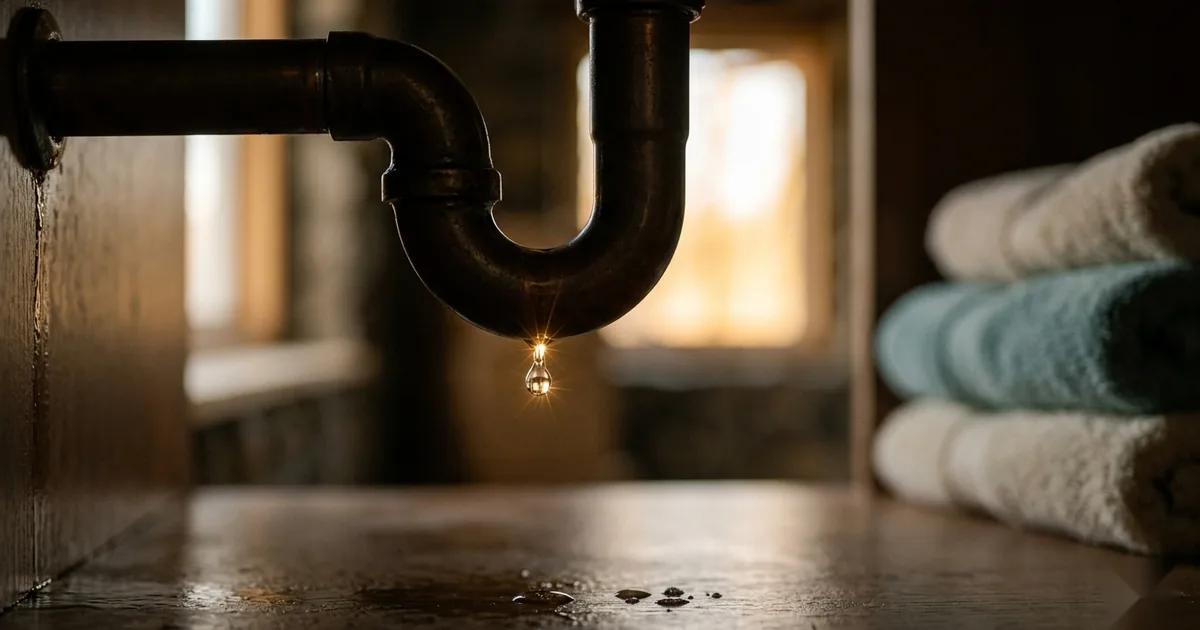
You’ve seen this drip before
You open the cabinet under the kitchen sink to grab the dish soap, and you notice it: a little dampness, maybe a slow drip from one of the fittings. Nothing dramatic. A single drop every so often. You think, “I’ll deal with that later,” you nudge the cleaning supplies aside, and you close the cabinet.
We have all done it. The drip is so small it does not feel like a problem. That is exactly why it becomes one. Here is the story of what happens next, because it plays out in homes everywhere, the same way, over and over.
Week one: the drip you forgot about
The drip keeps dripping. It is patient. A drop lands on the bottom of the cabinet, sits, and evaporates slowly in the enclosed space, keeping the wood damp. You do not think about it again, because from the outside, nothing has changed. The kitchen looks fine. Life goes on.
But inside that dark, closed cabinet, the material is now permanently wet, and wet wood is where the trouble starts.
Week three: the mold you cannot see yet
Mold needs only 24 to 48 hours of moisture to start, and that cabinet has given it weeks. Down in the damp, dark corner you never look at, mold begins to grow on the cabinet floor and the wall behind it. There is no dramatic sign. Maybe, if you leaned in close, a faint musty smell. But you are not leaning in; you are grabbing the dish soap and closing the door.
The problem is now actively growing, and it is completely out of sight.
Month two: the damage goes structural
The constant moisture has soaked through the cabinet floor into the subfloor beneath. The particleboard cabinet bottom is sagging and starting to crumble at the edges. The wood is soft. The mold has spread further up the wall. What started as a single drop of water is now quietly rotting the structure your kitchen sits on.
You still might not know, because the only evidence is inside the cabinet and under the floor. That is the cruel efficiency of a slow leak: it does its worst work precisely where you will not see it until it is significant.
The day you finally notice
Eventually, something gives it away. A smell you cannot ignore. A soft, spongy spot on the floor. A stain bleeding through to a surface you can see. You open the cabinet to actually look this time, and the story is written all over it: warped and crumbling cabinet, dark mold up the wall, a soft subfloor underneath.
Now the fix is not a two-dollar washer and ten minutes with a wrench, which is all it would have taken that first week. Now it is replacing the cabinet, repairing the subfloor, and remediating mold. A problem you could have solved for the cost of a coffee has become a project measured in thousands.
Why we ignore the small stuff, and why it costs us
There is nothing unusual about letting that slide. Ignoring a tiny drip is completely human. It seems too small to matter, we are busy, and it is not screaming for attention. The trouble is that water does not care whether a problem looks urgent. It just keeps working, slowly, patiently, in the dark, turning small into big while we are looking elsewhere.
The lesson is not “feel guilty about the drip.” It is simpler: small water problems do not stay small on their own. Left alone, they compound. The only question is whether you catch them near the start or discover them near the end.
The easiest version of the fix
You can catch these early the old-fashioned way, by taking that first drip seriously and fixing it the day you notice. That works, when you notice. The catch is that the most damaging leaks are the ones you never see at all, in cabinets, behind appliances, inside walls.
That is the whole reason we built a simpler backstop. Our spooresLEAK sensor sits in those hidden spots and alerts your phone the moment it detects moisture, so a drip cannot quietly run for weeks. Paired with the spooresVALVE automatic shutoff, it can even stop the water on its own. It is, essentially, a way to make sure the small thing gets caught while it is still small.
The takeaway
The drip under the sink is never really about the drip. It is about what it becomes when nobody is watching. The cheapest, easiest moment to deal with it is always the one you are tempted to skip, that first “I’ll deal with it later.” Deal with it now, or let something keep watch so it never gets the chance to grow.
Join the waitlist to be first in line for our leak detection and shutoff devices.